


Resting Blood Pressure
- Jan 8, 2024
- 2 min read
Purpose: To provide a basic indication of cardiovascular health & fitness, by assessing the force being exerted on the arterial walls, while the heart is contracting & relaxing.

Blood pressure is primarily dependent upon the volume of blood and the resistance of the blood vessels. The blood pressure that is commonly measured is that of the arteries. Typically, the brachial artery is sampled because of convenience and its position at heart level. The brachial artery is a continuation of the axillary artery and extends medially alongside the humerus.
The determination of blood pressure is based upon the sounds made by the vibrations from the vascular walls. These sounds are referred to as Korotkoff sounds (Don't worry, I still can't pronounce it right). When there is no blood flow (as when a tourniquet is applied), there will be no vibrations and therefore no sound. When there is completely non-obstructed flow of the blood, there is also no vibration and thus no sound; this is due to the stream-lined flow of blood. When blood flow is restricted by the application of a tourniquet or by any kind of pressure, and then gradually released, there will be a bolus of blood escaping at the peak point of blood pressure. This bolus of blood will cause vascular vibrations which result in a sharp thud (Korotkoff Phase 1): this is systolic pressure. As the restriction or pressure continues to be released, more blood escapes, causing even greater vibration and louder sounds.
As the cuff pressure is allowed to continually decrease, still more blood escapes until eventually there is stream-lined flow and no more vibrations or sound (Korotkoff Phase 5); this disappearance of sound denotes diastolic pressure, the lowest pressure that exists in the arteries. The following is a summary of Korotoff Phases:
Phase 1 Sharp thud=systolic blood pressure
Phase 2 Tapping
Phase 3 Tapping becoming fainter
Phase 4 Muffled sound: substantial decrease in sound intensity
Phase 5 Silence =diastolic blood pressure
Procedures:
– Choose properly sized cuff (should encircle 80% of upper arm)
– Place center of bladder directly over brachial artery
– Position lower edge of cuff ~1” above antecubital fossa
BP Measurement
Place stethoscope bell over brachial artery & hold with moderate pressure
Avoid inserting bell under cuff (may not be possible with very small arms, but try)
Release pressure at a rate of approximately 2-3 mm Hg
Record the SBP (1st phase) and DBP (5th phase)
Continue deflating cuff & listening for sounds for at least 10 mm Hg after determining DBP
Wait 1 minute & repeat measurement
Use the average of the two measurements as data
If the first two readings differ by more than 5 mm Hg, take additional readings.
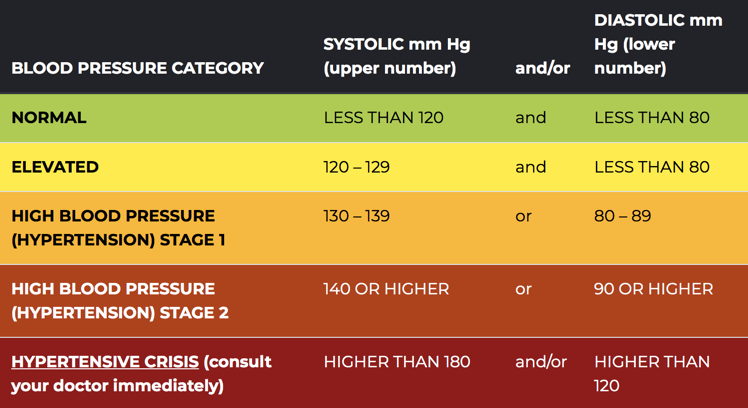
Reference:
Pescatello, Linda S., Deborah Riebe, and Paul D. Thompson, eds.ACSM's guidelines for exercise testing and prescription. Lippincott Williams & Wilkins, 2014.
https://www.heart.org/en/health-topics/high-blood-pressure/understanding-blood-pressure-readings


Comments